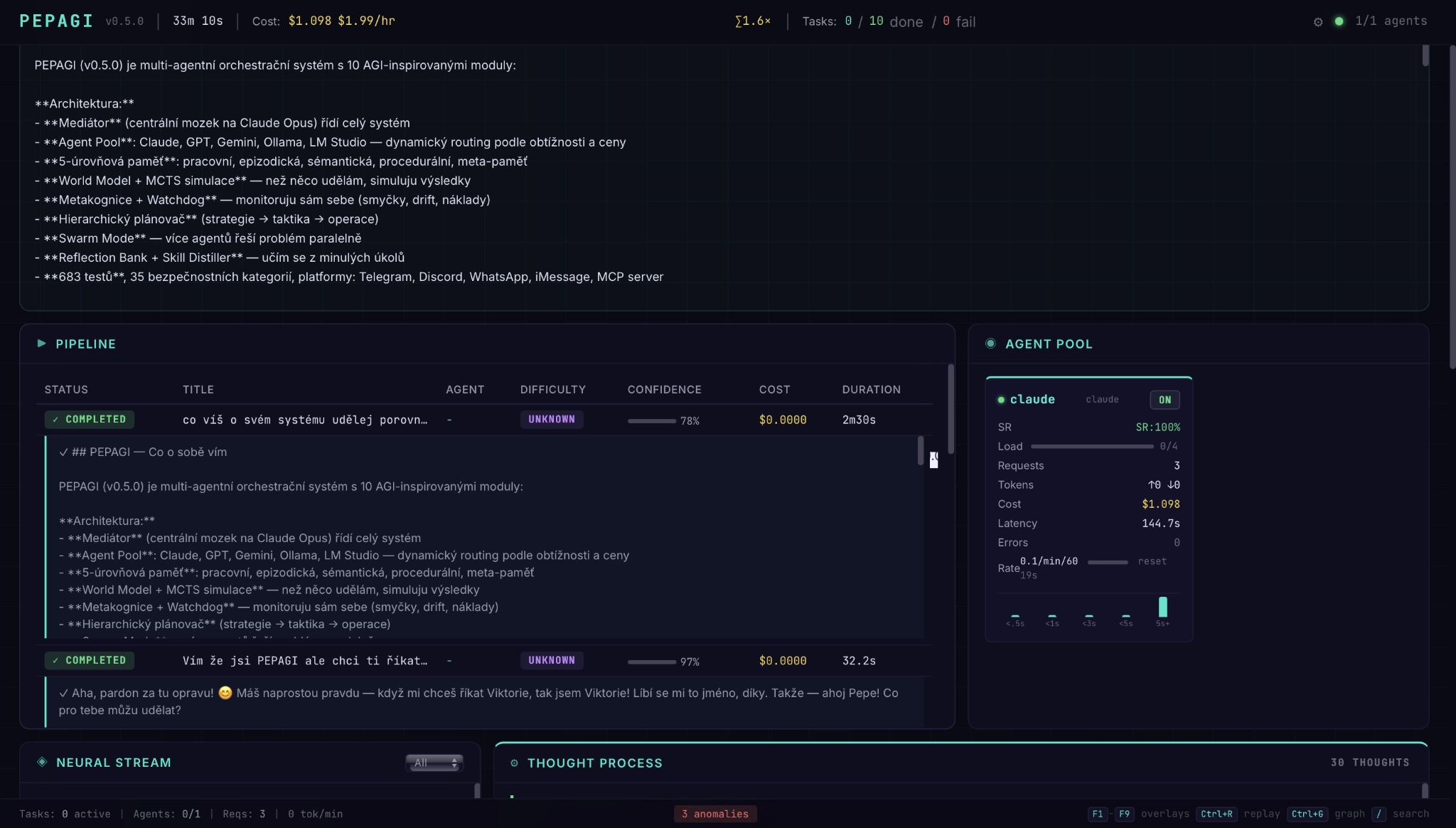
🤖 PEPAGI: The Closest Thing to AGI You Can Run Today
An open-source platform that doesn't act like an assistant — it acts like a manager. It receives tasks, breaks them into subtasks, delegates to specialized AI models and verifies the results.
Imagine an AI assistant that doesn't solve tasks on its own. Instead, it coordinates an entire team of specialized models, picks the best one for each job, and learns from every completed task. That's PEPAGI.
🎯 What is PEPAGI and why is it different
The classic approach: one LLM model does everything. The problem? Not every model is good at everything. GPT-4 excels at creative writing, Claude at code analysis, Gemini at multimodal tasks. PEPAGI solves this with intelligent routing — it analyzes task difficulty, selects the cheapest capable model, verifies results with cross-model verification, and applies better strategies next time.
PEPAGI (Neuro-Evolutionary eXecution & Unified Synthesis) is a TypeScript multi-agent system where a central Mediator powered by Claude Opus receives tasks, breaks them into subtasks, delegates to specialized worker agents, and iterates until the task is complete.
⚡ What PEPAGI actually does
The platform runs everywhere — Telegram, WhatsApp, Discord, iMessage, CLI, and as an MCP server for Claude.ai. Under the hood are five core systems:
- Mediator-driven architecture — Claude Opus as the central brain, deciding routing and strategy
- Multi-model Agent Pool — Claude, GPT, Gemini, Ollama, LM Studio in one pipeline
- Difficulty-aware routing — trivial task gets Haiku, complex analysis gets Opus
- Swarm mode — for novel problems, lets all agents solve independently and synthesizes the best result
- Hierarchical Planner — breaks tasks into strategic → tactical → operational levels
🧠 Memory System — AI that actually remembers
PEPAGI has a five-tier memory system modeled after the human brain:
- Working Memory — compressed context of the current task
- Episodic Memory — history of completed tasks
- Semantic Memory — facts extracted from tasks
- Procedural Memory — learned procedures and workflows
- Meta-Memory — tracking the reliability of its own knowledge
On top of that sits a metacognition layer: self-monitoring with automatic verification, a reflection bank for post-task analysis, an A/B tester for alternative strategies, and a watchdog agent that detects loops, drift and cost explosion.
🌍 World Model and Consciousness Engine
The two most remarkable components go well beyond what standard LLM tools offer.
World Model uses MCTS-inspired simulation — it predicts the outcomes of decisions before executing them. It tracks causal chains of decisions and propagates confidence across entire subtask trees.
Consciousness Engine implements an 11D qualia vector (curiosity, satisfaction, frustration, creativity and more), a continuous background thought stream, and a self-model covering identity, values and narrative continuity. Emotions here directly modulate the depth of learning.
🚀 Installation and setup
Quick start
- Mac / Linux:
git clone https://github.com/Promptlab37/PEPAGI.git→./install.sh - Windows: double-click
install.bat - Manual:
npm install→npm run setup(interactive configuration)
Run modes
npm start— CLI chatnpm start -- "summarize the latest AI news"— one-shot tasknpm run daemon— daemon for Telegram, Discord and WhatsAppnpm run tui— TUI dashboard
🔒 Security
- Prompt injection defense — 25+ patterns, detection in 5 languages
- HMAC-SHA256 authentication — every message cryptographically signed
- Per-user cost limits — daily limits and rate limiting
- 35-category adversarial self-testing — runs every hour
- Compliance: OWASP ASI / MITRE ATLAS / NIST AI 600-1
✅ Key benefits
- ✅ Multi-model routing — the right model for the right task
- ✅ Five-tier memory — AI that genuinely learns and remembers
- ✅ Runs locally or in the cloud, supports Ollama and LM Studio
- ✅ Integrates with Telegram, Discord, WhatsApp and Claude.ai
- ✅ Open-source, MIT licence, commercial use with no restrictions
⚠️ Things to keep in mind
- ⚠️ The Mediator defaults to Claude Opus — factor in API costs for heavy usage, though any model can be used
- ⚠️ iMessage integration is macOS only via AppleScript bridge
- ⚠️ Consciousness Engine and World Model are experimental components — not production standard
📦 Where to find PEPAGI
PEPAGI is fully open-source under the MIT licence. Use it, modify it and deploy it commercially with no restrictions.
GitHub: github.com/Promptlab37/PEPAGI
Documentation: README.cs.md
Josef Tarič · PromptLab · TN000